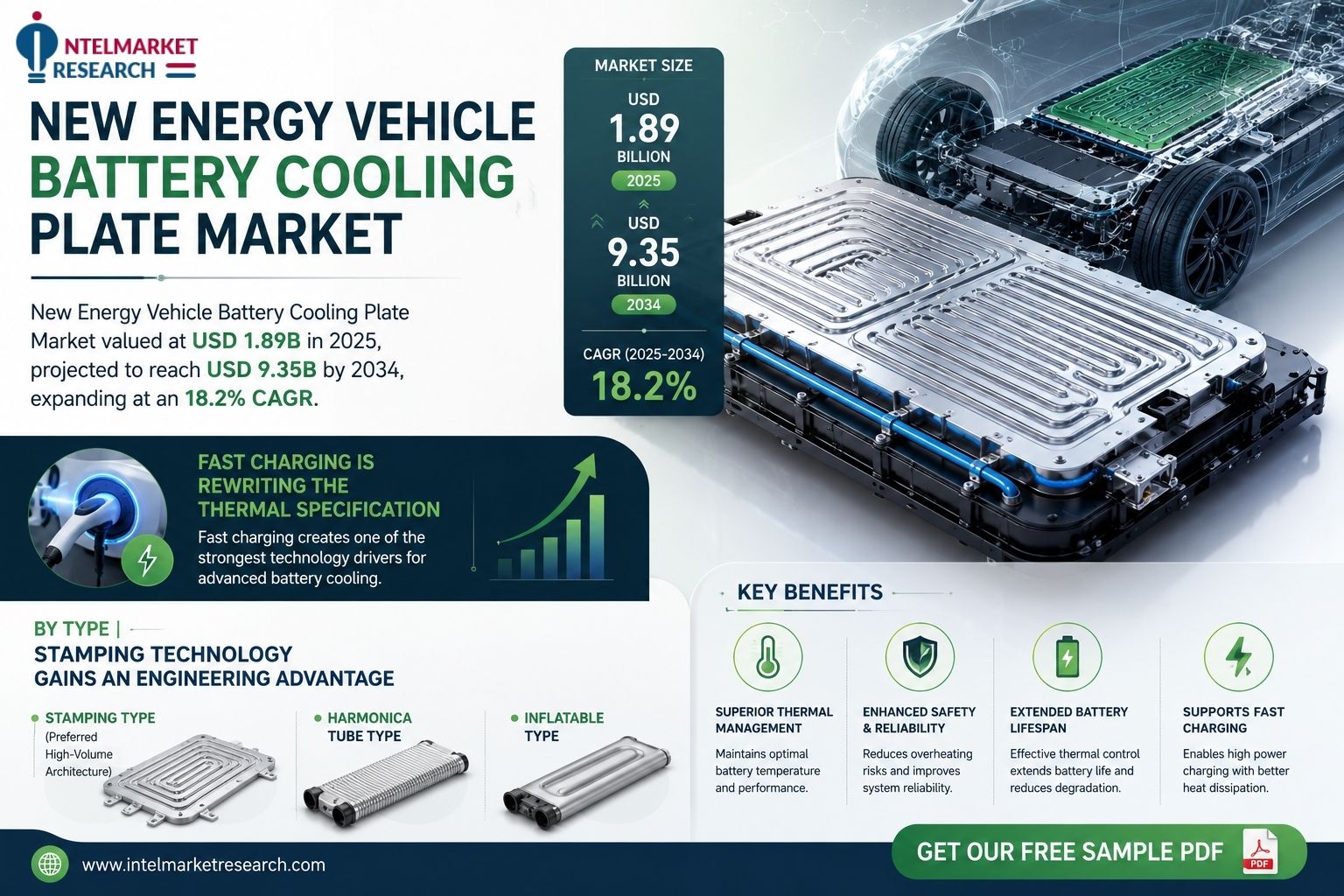
New Energy Vehicle Battery Cooling Plate Market valued at USD 1.89 Billion in 2025, projected to reach USD 9.35 Billion by 2034, expanding at an 18.2% CAGR.
PUNE, MAHARASHTRA, INDIA, August 31, 2026 /EINPresswire.com/ — The next competitive battleground in new energy vehicles (NEVs) is not limited to battery chemistry or charging speed. Increasingly, it is happening underneath the cells inside the battery thermal management architecture.
Global electric car sales exceeded 20 million units in 2025, representing roughly one in four new cars sold worldwide. At the same time, EV battery deployment reached approximately 1.2 TWh, nearly 30% higher than in 2024. The scale of battery deployment is making thermal management a much larger engineering and supply-chain opportunity.
This is where New Energy Vehicle Battery Cooling Plate Market is entering a new phase.
Battery cooling plates, traditionally viewed as engineered heat-transfer components, are increasingly being designed around the complete battery pack. Channel geometry, alloy selection, coolant distribution, pressure drop, structural integration, manufacturability and pack-level weight are becoming interconnected design decisions.
The market is therefore moving beyond the question of how to remove heat toward a more consequential question:
How can a cooling plate enable a better battery?
𝐖𝐡𝐲 𝟐𝟎𝟐𝟔 𝐈𝐬 𝐂𝐡𝐚𝐧𝐠𝐢𝐧𝐠 𝐭𝐡𝐞 𝐂𝐨𝐨𝐥𝐢𝐧𝐠-𝐏𝐥𝐚𝐭𝐞 𝐂𝐨𝐧𝐯𝐞𝐫𝐬𝐚𝐭𝐢𝐨𝐧?
The latest battery-development cycle is placing simultaneous pressure on several parameters:
• Higher battery energy density
• Faster charging requirements
• Greater instantaneous power demand
• Larger battery formats
• Cell-to-pack and cell-to-chassis architectures
• Lower vehicle weight
• Tighter packaging envelopes
• Greater expectations for battery life and safety
The International Energy Agency reports that prismatic cells account for more than 60% of EV and stationary-storage batteries globally. The agency also highlights the growing use of cooling plates between prismatic cells to accelerate heat removal, alongside cell-to-pack and cell-to-chassis architectures designed to improve energy density.
That shift has an important consequence: the cooling plate can no longer be optimized independently of the battery architecture.
A plate that delivers excellent heat transfer but adds excessive mass, pressure drop, manufacturing complexity or packaging constraints may not be the best commercial solution.
💠𝐀𝐜𝐜𝐞𝐬𝐬 𝐭𝐡𝐞 𝐒𝐚𝐦𝐩𝐥𝐞 𝐑𝐞𝐩𝐨𝐫𝐭 𝐏𝐃𝐅 𝐢𝐧𝐬𝐭𝐚𝐧𝐭𝐥𝐲: https://www.intelmarketresearch.com/download-free-sample/22153/new-energy-vehicle-battery-cooling-plate-market
𝐅𝐫𝐨𝐦 𝐅𝐥𝐚𝐭 𝐌𝐞𝐭𝐚𝐥 𝐏𝐥𝐚𝐭𝐞 𝐭𝐨 𝐄𝐧𝐠𝐢𝐧𝐞𝐞𝐫𝐞𝐝 𝐓𝐡𝐞𝐫𝐦𝐚𝐥 𝐀𝐫𝐜𝐡𝐢𝐭𝐞𝐜𝐭𝐮𝐫𝐞
• The new generation of cooling plates is becoming increasingly sophisticated.
• Serpentine channels, parallel-flow layouts, multi-pass configurations, localized cooling zones and topology-optimized geometries are being investigated to improve temperature uniformity while controlling pumping requirements.
• A 2026 Scientific Reports study examining a 288-cell prismatic battery pack investigated a serpentine liquid-cooled aluminum cold plate, reflecting the industry’s continued focus on balancing thermal performance with hydraulic efficiency.
• Another 2026 study explored stereoscopic-serpentine channel architecture and reported improved coolant flow and reduced battery temperature differences compared with a conventional serpentine bottom cold plate.
➢ 𝐌𝐚𝐫𝐤𝐞𝐭 𝐎𝐮𝐭𝐥𝐨𝐨𝐤: New Energy Vehicle Battery Cooling Plate Market was valued at USD 1,890 million in 2025 and is projected to reach USD 9,348 million by 2034, expanding at a CAGR of 18.2% during 2026-2034.
• The implication for manufacturers is significant: channel design is becoming a competitive engineering variable rather than simply a manufacturing detail.
𝐅𝐚𝐬𝐭 𝐂𝐡𝐚𝐫𝐠𝐢𝐧𝐠 𝐈𝐬 𝐑𝐞𝐰𝐫𝐢𝐭𝐢𝐧𝐠 𝐭𝐡𝐞 𝐓𝐡𝐞𝐫𝐦𝐚𝐥 𝐒𝐩𝐞𝐜𝐢𝐟𝐢𝐜𝐚𝐭𝐢𝐨𝐧
Fast charging creates one of the strongest technology drivers for advanced battery cooling.
Higher charging rates generate heat rapidly, while temperature differences between cells can accelerate uneven degradation and affect available battery performance. For vehicle manufacturers seeking shorter charging stops, thermal management must respond almost as quickly as the charging system itself.
Recent research is moving beyond conventional cold plates toward hybrid architectures. A 2026 Energy study combining heat pipes and liquid cold plates reported reductions in maximum temperature difference and pressure drop compared with the baseline configuration.
This indicates a broader direction for the market:
Future cooling plates are likely to be judged on thermal uniformity, hydraulic efficiency, structural integration and response under dynamic drive cycles not simply maximum heat-transfer capability.
💠𝐋𝐞𝐚𝐫𝐧 𝐌𝐨𝐫𝐞 𝐢𝐧 𝐭𝐡𝐞 𝐅𝐮𝐥𝐥 𝐌𝐚𝐫𝐤𝐞𝐭 𝐑𝐞𝐩𝐨𝐫𝐭: https://www.intelmarketresearch.com/new-energy-vehicle-battery-cooling-plate-market-22153
𝐒𝐞𝐠𝐦𝐞𝐧𝐭 𝐀𝐧𝐚𝐥𝐲𝐬𝐢𝐬
◾𝐁𝐲 𝐓𝐲𝐩𝐞 | 𝐒𝐭𝐚𝐦𝐩𝐢𝐧𝐠 𝐓𝐞𝐜𝐡𝐧𝐨𝐥𝐨𝐠𝐲 𝐆𝐚𝐢𝐧𝐬 𝐚𝐧 𝐄𝐧𝐠𝐢𝐧𝐞𝐞𝐫𝐢𝐧𝐠 𝐀𝐝𝐯𝐚𝐧𝐭𝐚𝐠𝐞
• Stamping Type (Preferred High-Volume Architecture)
• Harmonica Tube Type
• Inflatable Type
𝗪𝗵𝘆 𝗪𝗮𝘁𝗲𝗿-𝗚𝗹𝘆𝗰𝗼𝗹 𝗟𝗲𝗮𝗱𝘀: Stamped cooling plates allow manufacturers to create optimized internal flow paths while keeping weight and material consumption under control. Their design flexibility is particularly useful for newer cell-to-pack (CTP) and cell-to-chassis (CTC) architectures, where thermal management needs to occupy less space inside increasingly compact battery systems.
◾𝐁𝐲 𝐀𝐩𝐩𝐥𝐢𝐜𝐚𝐭𝐢𝐨𝐧 | 𝐁𝐄𝐕𝐬 𝐒𝐞𝐭 𝐭𝐡𝐞 𝐓𝐡𝐞𝐫𝐦𝐚𝐥-𝐌𝐚𝐧𝐚𝐠𝐞𝐦𝐞𝐧𝐭 𝐁𝐞𝐧𝐜𝐡𝐦𝐚𝐫𝐤
• Battery Electric Vehicles (BEVs) (Primary Demand Segment)
• Plug-in Hybrid Electric Vehicles (PHEVs)
• Others
𝗪𝗵𝘆 𝗪𝗮𝘁𝗲𝗿-𝗚𝗹𝘆𝗰𝗼𝗹 𝗟𝗲𝗮𝗱𝘀: Battery-electric vehicles generally rely on larger battery packs and increasingly support high-power DC charging, creating greater requirements for controlled heat removal. As charging speeds increase, maintaining temperature uniformity across the battery becomes increasingly important for performance, durability and charging consistency.
The shift toward 800 V electrical architectures is adding another layer to thermal-management requirements, particularly in premium and high-performance EV platforms.
◾𝐁𝐲 𝐄𝐧𝐝 𝐔𝐬𝐞𝐫 | 𝐎𝐄𝐌 𝐈𝐧𝐭𝐞𝐠𝐫𝐚𝐭𝐢𝐨𝐧 𝐈𝐬 𝐑𝐞𝐝𝐞𝐟𝐢𝐧𝐢𝐧𝐠 𝐂𝐨𝐦𝐩𝐨𝐧𝐞𝐧𝐭 𝐏𝐫𝐨𝐜𝐮𝐫𝐞𝐦𝐞𝐧𝐭
• OEMs (Largest Demand Contributor)
• Battery Manufacturers
• Aftermarket
𝗪𝗵𝘆 𝗪𝗮𝘁𝗲𝗿-𝗚𝗹𝘆𝗰𝗼𝗹 𝗟𝗲𝗮𝗱𝘀: Cooling plates are increasingly developed alongside battery packs rather than treated as standalone components. This encourages closer engineering relationships between automakers, battery-system developers and thermal-management suppliers, particularly when manufacturers are optimizing the complete pack for weight, charging speed and production efficiency.
◾𝐁𝐲 𝐌𝐚𝐭𝐞𝐫𝐢𝐚𝐥 | 𝐀𝐥𝐮𝐦𝐢𝐧𝐮𝐦 𝐀𝐥𝐥𝐨𝐲 𝐑𝐞𝐦𝐚𝐢𝐧𝐬 𝐭𝐡𝐞 𝐋𝐢𝐠𝐡𝐭𝐰𝐞𝐢𝐠𝐡𝐭 𝐖𝐨𝐫𝐤𝐡𝐨𝐫𝐬𝐞
• Aluminum Alloy (Preferred Material)
• Copper
• Composite Materials
𝗪𝗵𝘆 𝗪𝗮𝘁𝗲𝗿-𝗚𝗹𝘆𝗰𝗼𝗹 𝗟𝗲𝗮𝗱𝘀: Aluminum provides a practical balance between thermal performance, low density, cost and manufacturability. Its compatibility with stamping, extrusion, brazing and automated assembly also makes it well suited to high-volume EV production.
Copper offers higher thermal conductivity but introduces a weight and cost penalty, while composite materials remain an area of development for applications where designers prioritize advanced thermal performance and weight reduction.
◾𝐁𝐲 𝐂𝐨𝐨𝐥𝐢𝐧𝐠 𝐌𝐞𝐝𝐢𝐮𝐦 | 𝐖𝐚𝐭𝐞𝐫-𝐆𝐥𝐲𝐜𝐨𝐥 𝐑𝐞𝐦𝐚𝐢𝐧𝐬 𝐭𝐡𝐞 𝐏𝐫𝐨𝐯𝐞𝐧 𝐂𝐡𝐨𝐢𝐜𝐞
• Water-Glycol (Established Automotive Standard)
• Phase Change Materials
• Dielectric Fluids
𝗪𝗵𝘆 𝗪𝗮𝘁𝗲𝗿-𝗚𝗹𝘆𝗰𝗼𝗹 𝗟𝗲𝗮𝗱𝘀: Water-glycol systems have an established automotive supply chain and proven performance across a wide operating range. Their relatively straightforward integration with vehicle thermal circuits gives OEMs a practical solution for controlling battery temperature without introducing the complexity associated with newer cooling media.
𝐓𝐡𝐞 𝐌𝐨𝐬𝐭 𝐈𝐧𝐭𝐞𝐫𝐞𝐬𝐭𝐢𝐧𝐠 𝐒𝐡𝐢𝐟𝐭: 𝐂𝐨𝐨𝐥𝐢𝐧𝐠 𝐏𝐥𝐚𝐭𝐞𝐬 𝐀𝐫𝐞 𝐁𝐞𝐜𝐨𝐦𝐢𝐧𝐠 𝐒𝐭𝐫𝐮𝐜𝐭𝐮𝐫𝐚𝐥
A key development in EV battery-pack design is the integration of thermal management with mechanical protection. Because battery packs occupy critical underbody space, adding separate cooling, structural, and protective components can increase vehicle weight, packaging complexity, and cost.
An integrated cooling-protection plate offers a more efficient solution by combining thermal regulation, underbody impact resistance, structural support, and packaging functions within a single component. A 2026 SAE technical paper reported that such a design reduced module weight by approximately 14%, while integrated structural crash members improved energy absorption by 33% compared with a design without these members.
This multi-functional approach represents an important market opportunity, particularly as manufacturers move toward cell-to-pack and cell-to-chassis architectures, where lightweight, compact, and structurally efficient battery systems become increasingly important.
💠𝐔𝐧𝐥𝐨𝐜𝐤 𝐏𝐫𝐞𝐦𝐢𝐮𝐦 𝐊𝐞𝐲 𝐓𝐚𝐤𝐞𝐚𝐰𝐚𝐲𝐬 𝐟𝐫𝐨𝐦 𝐎𝐮𝐫 𝐔𝐩𝐝𝐚𝐭𝐞𝐝 𝐒𝐚𝐦𝐩𝐥𝐞 𝐑𝐞𝐩𝐨𝐫𝐭: https://www.intelmarketresearch.com/download-free-sample/22153/new-energy-vehicle-battery-cooling-plate-market
𝐂𝐨𝐦𝐩𝐞𝐭𝐢𝐭𝐢𝐯𝐞 𝐁𝐚𝐭𝐭𝐥𝐞𝐟𝐢𝐞𝐥𝐝 | 𝐓𝐡𝐞 𝐑𝐚𝐜𝐞 𝐈𝐬 𝐒𝐡𝐢𝐟𝐭𝐢𝐧𝐠 𝐅𝐫𝐨𝐦 𝐂𝐨𝐨𝐥𝐢𝐧𝐠 𝐇𝐚𝐫𝐝𝐰𝐚𝐫𝐞 𝐭𝐨 𝐈𝐧𝐭𝐞𝐠𝐫𝐚𝐭𝐞𝐝 𝐓𝐡𝐞𝐫𝐦𝐚𝐥 𝐀𝐫𝐜𝐡𝐢𝐭𝐞𝐜𝐭𝐮𝐫𝐞
Competition in the New Energy Vehicle Battery Cooling Plate Market is increasingly centered on flow-channel engineering, lightweight construction, manufacturing scalability, leak prevention and integration with complete battery thermal-management systems.
The strongest suppliers are no longer competing simply on the ability to manufacture a metal plate. They are competing on how effectively that plate works inside a complete battery system.
Key Companies Profiled;
🔸Valeo
🔸MAHLE
🔸Yinlun Holdings
🔸Sanhua Auto Parts
🔸Nabaichuan
🔸Dana
🔸Boyd Corporation
🔸Cotran
🔸Modine Manufacturing
🔸ESTRA Automotive
🔸ONEGENE
🔸Hubei Reddit Cooling System
🔸Trumony Aluminum
🔸Runthrough Heat Exchange
🔸Shenzhen FRD
𝐀𝐥𝐮𝐦𝐢𝐧𝐮𝐦 𝐑𝐞𝐦𝐚𝐢𝐧𝐬 𝐈𝐦𝐩𝐨𝐫𝐭𝐚𝐧𝐭 𝐛𝐮𝐭 𝐌𝐚𝐭𝐞𝐫𝐢𝐚𝐥 𝐈𝐧𝐧𝐨𝐯𝐚𝐭𝐢𝐨𝐧 𝐈𝐬 𝐀𝐜𝐜𝐞𝐥𝐞𝐫𝐚𝐭𝐢𝐧𝐠
Aluminum continues to be a prominent material choice because it offers a useful combination of thermal conductivity, low density, corrosion resistance and manufacturing flexibility.
However, the engineering requirements are changing.
As battery packs become larger and more powerful, cooling plates must tolerate higher thermal loads while meeting mechanical and dimensional requirements. Recent automotive engineering work has therefore focused on aluminum alloy development for next-generation EV cold plates, specifically addressing the trade-off between strength and thermal conductivity.
The competitive material landscape is consequently evolving around:
• High-conductivity aluminum alloys
• Lightweight multi-layer constructions
• Brazed and welded assemblies
• Extruded channel architectures
• Advanced surface and interface treatments
• Hybrid thermal materials
• Additively manufactured geometries for specialized applications
For suppliers, the opportunity is no longer limited to supplying aluminum plates. It increasingly involves delivering application-specific thermal architectures.
The Market Is Also Being Challenged by Technologies beyond Conventional Cold Plates
Cooling plates remain highly relevant, but they are not operating in isolation.
• Immersion cooling, phase-change materials, heat pipes and hybrid thermal systems are being actively investigated for high-energy-density applications.
• A 2025 vehicle-scale study of immersion cooling used a 30.7 kWh module containing 48 lithium-ion cells and demonstrated substantial improvement in temperature uniformity compared with a benchmark bottom cold-plate system.
• Meanwhile, a 2026 review of phase-change-material-based battery thermal management identified hybrid architectures capable of reducing maximum battery temperature by approximately 22-40%, depending on configuration and operating conditions.
• These technologies do not necessarily replace cooling plates immediately. Instead, they create a more competitive thermal-management ecosystem.
Conventional liquid cooling → advanced cold plates → hybrid thermal architectures → immersion and other high-performance systems.
💠𝐆𝐞𝐭 𝐈𝐧𝐬𝐭𝐚𝐧𝐭 𝐀𝐜𝐜𝐞𝐬𝐬 𝐭𝐨 𝐎𝐮𝐫 𝐋𝐚𝐭𝐞𝐬𝐭 𝐑𝐞𝐬𝐞𝐚𝐫𝐜𝐡 𝐇𝐢𝐠𝐡𝐥𝐢𝐠𝐡𝐭𝐬: https://www.intelmarketresearch.com/new-energy-vehicle-battery-cooling-plate-market-22153
𝐓𝐡𝐞 𝐑𝐞𝐚𝐥 𝐃𝐢𝐟𝐟𝐞𝐫𝐞𝐧𝐭𝐢𝐚𝐭𝐨𝐫: 𝐓𝐞𝐦𝐩𝐞𝐫𝐚𝐭𝐮𝐫𝐞 𝐔𝐧𝐢𝐟𝐨𝐫𝐦𝐢𝐭𝐲
While peak temperature remains an important thermal-management metric, temperature uniformity across the battery pack is becoming equally critical. A pack may maintain an acceptable average temperature while individual cells or regions experience significant thermal gradients, accelerating degradation and creating inconsistencies in long-term performance.
➣ This need for precise thermal control is gaining importance as New Energy Vehicle Battery Cooling Plate Market is projected to expand from USD USD 1,890 million in 2025 in 2025 to USD 9,348 million by 2034, reflecting an 18.2% CAGR.
A March 2026 study of multiple cooling plates highlighted that variations in cooling-plate performance can contribute to uneven temperature distribution, increasing the risk of battery degradation and potential failure. The most effective cooling plate, therefore, is not simply the one that removes the greatest amount of heat, but the one that maintains consistent thermal conditions across the entire pack. This shift toward uniformity is expected to influence future cooling-plate designs, simulation requirements, and OEM sourcing decisions.
𝐑𝐞𝐠𝐢𝐨𝐧𝐚𝐥 𝐌𝐚𝐫𝐤𝐞𝐭 𝐏𝐮𝐥𝐬𝐞 | 𝐄𝐕 𝐏𝐫𝐨𝐝𝐮𝐜𝐭𝐢𝐨𝐧 𝐈𝐬 𝐒𝐡𝐚𝐩𝐢𝐧𝐠 𝐂𝐨𝐨𝐥𝐢𝐧𝐠 𝐏𝐥𝐚𝐭𝐞 𝐃𝐞𝐦𝐚𝐧𝐝
🔸𝐍𝐨𝐫𝐭𝐡 𝐀𝐦𝐞𝐫𝐢𝐜𝐚 | 𝐋𝐨𝐜𝐚𝐥𝐢𝐳𝐚𝐭𝐢𝐨𝐧 𝐓𝐚𝐤𝐞𝐬 𝐏𝐫𝐢𝐨𝐫𝐢𝐭𝐲
o Strong EV and battery manufacturing investments are increasing demand for lightweight, OEM-integrated cooling plates, particularly for larger battery packs and fast-charging platforms.
🔸 𝐄𝐮𝐫𝐨𝐩𝐞 | 𝐄𝐧𝐠𝐢𝐧𝐞𝐞𝐫𝐢𝐧𝐠-𝐋𝐞𝐝 𝐆𝐫𝐨𝐰𝐭𝐡
o Europe’s advanced EV platforms are driving demand for compact, lightweight and highly efficient thermal-management solutions, with OEMs focusing on integrated battery architectures.
🔸 𝐀𝐬𝐢𝐚-𝐏𝐚𝐜𝐢𝐟𝐢𝐜 | 𝐌𝐚𝐧𝐮𝐟𝐚𝐜𝐭𝐮𝐫𝐢𝐧𝐠 𝐏𝐨𝐰𝐞𝐫𝐡𝐨𝐮𝐬𝐞
o China, Japan and South Korea benefit from extensive EV and battery manufacturing ecosystems, supporting large-scale adoption of aluminum cooling plates and advanced flow-channel designs.
🔸 𝐋𝐚𝐭𝐢𝐧 𝐀𝐦𝐞𝐫𝐢𝐜𝐚 | 𝐄𝐦𝐞𝐫𝐠𝐢𝐧𝐠 𝐏𝐫𝐨𝐝𝐮𝐜𝐭𝐢𝐨𝐧 𝐎𝐩𝐩𝐨𝐫𝐭𝐮𝐧𝐢𝐭𝐲
o Brazil and Mexico are developing EV ecosystems around established automotive manufacturing bases, creating gradual opportunities for battery thermal-management suppliers.
🔸𝐌𝐢𝐝𝐝𝐥𝐞 𝐄𝐚𝐬𝐭 & 𝐀𝐟𝐫𝐢𝐜𝐚 | 𝐄𝐚𝐫𝐥𝐲-𝐒𝐭𝐚𝐠𝐞 𝐛𝐮𝐭 𝐏𝐫𝐨𝐦𝐢𝐬𝐢𝐧𝐠
o EV adoption, fleet electrification and hot-climate operating conditions are increasing attention toward reliable battery cooling technologies.
𝐖𝐡𝐚𝐭 𝐁𝐮𝐲𝐞𝐫𝐬 𝐖𝐢𝐥𝐥 𝐋𝐨𝐨𝐤 𝐟𝐨𝐫 𝐁𝐞𝐲𝐨𝐧𝐝 𝐏𝐫𝐢𝐜𝐞?
Procurement of battery cooling plates is becoming increasingly performance-driven, with automotive and battery manufacturers assessing suppliers on a broader set of technical and commercial parameters. Key evaluation criteria include heat-transfer efficiency, temperature uniformity, pressure drop, coolant compatibility, leak and corrosion resistance, dimensional accuracy, and weight relative to thermal capacity.
Manufacturers also consider the reliability of joining and brazing processes, production scalability, ease of integration with battery-pack structures, and total lifecycle cost. As a result, suppliers that combine thermal simulation, materials expertise, precision manufacturing, and battery-pack engineering can create a stronger competitive advantage than those competing mainly on component price.
💠𝐐𝐮𝐢𝐜𝐤 𝐩𝐞𝐞𝐤 𝐢𝐧𝐭𝐨 𝐦𝐚𝐫𝐤𝐞𝐭 𝐭𝐫𝐞𝐧𝐝𝐬, 𝐝𝐨𝐰𝐧𝐥𝐨𝐚𝐝 𝐧𝐨𝐰: https://www.intelmarketresearch.com/download-free-sample/22153/new-energy-vehicle-battery-cooling-plate-market
𝐖𝐡𝐞𝐫𝐞 𝐂𝐨𝐦𝐦𝐞𝐫𝐜𝐢𝐚𝐥 𝐎𝐩𝐩𝐨𝐫𝐭𝐮𝐧𝐢𝐭𝐲 𝐈𝐬 𝐂𝐨𝐧𝐜𝐞𝐧𝐭𝐫𝐚𝐭𝐢𝐧𝐠?
𝟭. 𝗛𝗶𝗴𝗵-𝗲𝗻𝗲𝗿𝗴𝘆-𝗱𝗲𝗻𝘀𝗶𝘁𝘆 𝗽𝗮𝘀𝘀𝗲𝗻𝗴𝗲𝗿 𝗘𝗩𝘀;
– Larger battery packs require greater thermal control without allowing cooling hardware to consume excessive space or weight.
𝟮. 𝗙𝗮𝘀𝘁-𝗰𝗵𝗮𝗿𝗴𝗶𝗻𝗴 𝗽𝗹𝗮𝘁𝗳𝗼𝗿𝗺𝘀;
– Higher charging rates intensify heat generation and increase demand for rapid, uniform thermal dissipation.
𝟯. 𝗖𝗼𝗺𝗺𝗲𝗿𝗰𝗶𝗮𝗹 𝗲𝗹𝗲𝗰𝘁𝗿𝗶𝗰 𝘃𝗲𝗵𝗶𝗰𝗹𝗲𝘀;
– Electric buses, trucks and fleet vehicles can experience demanding duty cycles, making durability and thermal consistency particularly important.
𝟰. 𝗣𝗿𝗲𝗺𝗶𝘂𝗺 𝗮𝗻𝗱 𝗽𝗲𝗿𝗳𝗼𝗿𝗺𝗮𝗻𝗰𝗲 𝗘𝗩𝘀;
– High-power acceleration, repeated charging and demanding driving cycles create a strong requirement for advanced thermal control.
𝐀 𝐌𝐚𝐫𝐤𝐞𝐭 𝐌𝐨𝐯𝐢𝐧𝐠 𝐓𝐨𝐰𝐚𝐫𝐝 𝐈𝐧𝐭𝐞𝐠𝐫𝐚𝐭𝐢𝐨𝐧, 𝐍𝐨𝐭 𝐉𝐮𝐬𝐭 𝐂𝐨𝐨𝐥𝐢𝐧𝐠
New Energy Vehicle Battery Cooling Plate Market is entering an important transition. The industry’s early objective was straightforward: remove heat from the battery.
The new objective is broader: control heat, equalize temperatures, support fast charging, reduce weight, protect the pack, simplify integration and enable higher energy density.
That is why the next generation of cooling plates is likely to look less like standardized metal components and more like customized thermal platforms engineered around specific battery architectures.
As global EV battery deployment continues to expand, the addressable opportunity is also broadening across battery manufacturers, automotive OEMs, thermal-management specialists, aluminum processors, precision fabricators and advanced-material suppliers. With EV battery deployment already reaching 1.2 TWh in 2025, the scale of this transition is becoming difficult to ignore.
𝐁𝐞𝐲𝐨𝐧𝐝 𝐭𝐡𝐞 𝐂𝐨𝐦𝐩𝐨𝐧𝐞𝐧𝐭: 𝐖𝐡𝐚𝐭 𝐓𝐡𝐢𝐬 𝐌𝐚𝐫𝐤𝐞𝐭 𝐑𝐞𝐩𝐨𝐫𝐭 𝐑𝐞𝐯𝐞𝐚𝐥𝐬
• Understanding New Energy Vehicle Battery Cooling Plate Market requires looking beyond shipment volumes and component demand.
• The real market story is being shaped by battery architecture, charging behavior, material innovation, thermal uniformity, manufacturing economics and the race toward integrated vehicle platforms.
• Our market assessment goes deeper into these shifts to identify where demand is developing, which technology approaches are gaining relevance, how application requirements are changing, and where suppliers can position themselves before thermal management becomes an even more decisive EV design constraint.
• The report provides a strategic view of the market across technology, material, cooling architecture, vehicle type, battery configuration, application, regional dynamics, competitive developments and emerging opportunities, helping decision-makers distinguish short-term component demand from longer-term technology shifts.
For companies building the next generation of electric mobility, the cooling plate is no longer simply where the heat goes it is becoming part of how the battery itself is designed to perform.
💠𝐒𝐭𝐚𝐲 𝐀𝐡𝐞𝐚𝐝 𝐰𝐢𝐭𝐡 𝐎𝐮𝐫 𝐅𝐮𝐥𝐥 𝐔𝐩𝐝𝐚𝐭𝐞𝐝 𝐑𝐞𝐬𝐞𝐚𝐫𝐜𝐡 𝐑𝐞𝐩𝐨𝐫𝐭 𝐇𝐞𝐫𝐞 𝐁𝐞𝐥𝐨𝐰: https://www.intelmarketresearch.com/new-energy-vehicle-battery-cooling-plate-market-22153
💠𝐃𝐨𝐰𝐧𝐥𝐨𝐚𝐝 𝐨𝐮𝐫 𝐒𝐚𝐦𝐩𝐥𝐞 𝐑𝐞𝐩𝐨𝐫𝐭 𝐟𝐨𝐫 𝐚 𝐬𝐧𝐞𝐚𝐤 𝐩𝐞𝐞𝐤 𝐢𝐧𝐭𝐨 𝐦𝐚𝐫𝐤𝐞𝐭 𝐝𝐲𝐧𝐚𝐦𝐢𝐜𝐬: https://www.intelmarketresearch.com/download-free-sample/22153/new-energy-vehicle-battery-cooling-plate-market
𝐄𝐱𝐩𝐥𝐨𝐫𝐞 𝐎𝐮𝐫 𝐑𝐞𝐥𝐚𝐭𝐞𝐝 𝐑𝐞𝐩𝐨𝐫𝐭𝐬:
➤ 𝗡𝗲𝘄 𝗘𝗻𝗲𝗿𝗴𝘆 𝗩𝗲𝗵𝗶𝗰𝗹𝗲 𝗕𝗟𝗗𝗖 𝗪𝗮𝘁𝗲𝗿 𝗣𝘂𝗺𝗽 𝗠𝗮𝗿𝗸𝗲𝘁: https://www.intelmarketresearch.com/new-energy-vehicle-bldc-water-pump-market-58013
➤ 𝗡𝗲𝘄 𝗘𝗻𝗲𝗿𝗴𝘆 𝗩𝗲𝗵𝗶𝗰𝗹𝗲 𝗕𝗮𝘁𝘁𝗲𝗿𝘆 𝗔𝗳𝘁𝗲𝗿𝗺𝗮𝗿𝗸𝗲𝘁 𝗠𝗮𝗿𝗸𝗲𝘁: https://www.intelmarketresearch.com/new-energy-vehicle-battery-aftermarket-market-25379
➤ 𝗕𝗮𝘁𝘁𝗲𝗿𝘆 𝗖𝗼𝗼𝗹𝗶𝗻𝗴 𝗦𝘆𝘀𝘁𝗲𝗺𝘀 𝗠𝗮𝗿𝗸𝗲𝘁: https://www.intelmarketresearch.com/battery-cooling-systems-market-market-36365
➤ 𝗣𝗮𝘀𝘀𝗲𝗻𝗴𝗲𝗿 𝗖𝗮𝗿 𝗕𝗮𝘁𝘁𝗲𝗿𝘆 𝗖𝗼𝗼𝗹𝗶𝗻𝗴 𝗣𝗹𝗮𝘁𝗲 𝗠𝗮𝗿𝗸𝗲𝘁: https://www.intelmarketresearch.com/passenger-car-battery-cooling-plate-market-22096
➤𝗡𝗲𝘄 𝗘𝗻𝗲𝗿𝗴𝘆 𝗩𝗲𝗵𝗶𝗰𝗹𝗲𝘀 𝗔𝗹𝘂𝗺𝗶𝗻𝘂𝗺 𝗖𝗮𝘀𝘁𝗶𝗻𝗴 𝗠𝗮𝗿𝗸𝗲𝘁: https://www.24chemicalresearch.com/reports/283775/global-regional-new-energy-vehicles-aluminum-casting-forecast-supply-dem-analysis-competitive-market
➤𝗡𝗲𝘄 𝗘𝗻𝗲𝗿𝗴𝘆 𝗩𝗲𝗵𝗶𝗰𝗹𝗲 𝗧𝗿𝗮𝗻𝘀𝗶𝗲𝗻𝘁 𝗦𝘂𝗽𝗽𝗿𝗲𝘀𝘀𝗶𝗼𝗻 𝗗𝗶𝗼𝗱𝗲𝘀 𝗠𝗮𝗿𝗸𝗲𝘁: https://semiconductorinsight.com/report/new-energy-vehicle-transient-suppression-diodes-market/
𝐀𝐛𝐨𝐮𝐭 𝐈𝐧𝐭𝐞𝐥 𝐌𝐚𝐫𝐤𝐞𝐭 𝐑𝐞𝐬𝐞𝐚𝐫𝐜𝐡
Intel Market Research is a leading provider of strategic intelligence, offering actionable insights in robotics, automation, and advanced manufacturing technologies. Our research capabilities include:
• Real-time competitive benchmarking
• Global technology innovation monitoring
• Country-specific regulatory and industry analysis
• Over 500+ technology and manufacturing reports annually
Trusted by Fortune 500 companies, our insights empower decision-makers to drive innovation with confidence.
🌐 𝐖𝐞𝐛𝐬𝐢𝐭𝐞: https://www.intelmarketresearch.com
🔗 𝐋𝐢𝐧𝐤𝐞𝐝𝐈𝐧: https://www.linkedin.com/company/intel-market-research
Rohan
IntelMarketResearch
+91 91691 64321
email us here
Visit us on social media:
LinkedIn
Facebook
YouTube
X
Legal Disclaimer:
EIN Presswire provides this news content “as is” without warranty of any kind. We do not accept any responsibility or liability
for the accuracy, content, images, videos, licenses, completeness, legality, or reliability of the information contained in this
article. If you have any complaints or copyright issues related to this article, kindly contact the author above.

Media gallery