
SHENZHEN, GUANGDONG, CHINA, November 24, 2026 /EINPresswire.com/ — How do global skincare and cosmetic brands prevent active ingredients from oxidizing before reaching the consumer? How can procurement teams balance rapid product launches with increasingly strict environmental mandates in Europe and North America? And most importantly, when sourcing packaging overseas, how do you identify the Right Airless Bottle Supplier capable of delivering consistent mechanical performance at scale?
Selecting an international cosmetic airless bottle manufacturer requires looking far beyond unit pricing. For B2B buyers evaluating custom airless packaging partners in China and across Asia, a reliable supplier must demonstrate proven engineering precision, regulatory readiness, transparent lead times, and end-to-end customization capabilities.
1. Evaluate Engineering Precision and Product Portfolio Depth
When assessing potential suppliers, buyers should examine both the breadth of standard stock molds and the engineering sophistication behind specific airless mechanisms. A capable wholesale airless pump bottle supplier should offer diverse formats-ranging from sleek cylindrical PP and acrylic bottles to dual-chamber systems, airless jars, and travel-sized dispensers-allowing brands to maintain visual cohesion across an entire skincare or color cosmetics line.
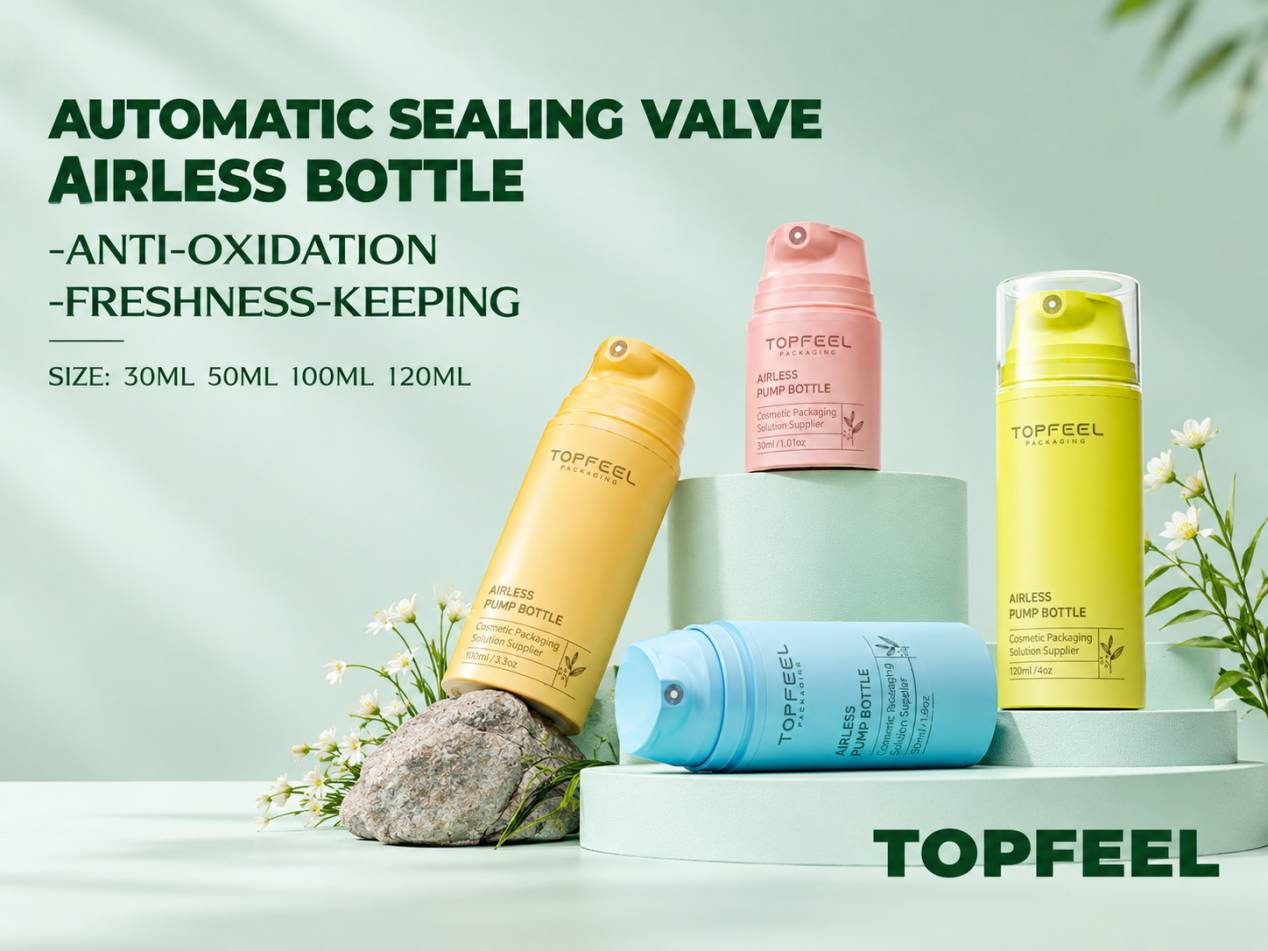
Technical innovation within the pump engine itself is equally important. Traditional airless pumps often contain internal metal springs that come into direct contact with the formulation, posing a risk of corrosion or chemical interaction with acidic or high-potency serums. Leading manufacturers address this by offering metal-free airless pump bottles where the spring is isolated outside the fluid pathway, ensuring formula purity and enhancing recyclability. For instance, Topfeelpack, a professional cosmetics packaging supplier specializing in R&D, manufacturing, and global marketing, integrates these precision engineering standards across an extensive portfolio that spans airless bottles, lotion bottles, cream jars, dropper bottles, cosmetic tubes, pumps, sticks, and custom dispensers. During initial vetting, procurement teams should request technical drawings and inquire about actuator dosage consistency, vacuum seal integrity, and residual rate testing across different product viscosities.
2. Verify In-House Manufacturing Capacity and Quality Control
Many entities operating in international packaging trade function primarily as intermediaries rather than direct factories, which can introduce communication delays, markup layers, and inconsistent quality oversight. Buyers searching for a dependable OEM/ODM airless packaging supplier should verify whether a prospective partner owns its production facilities, injection molding machines, assembly lines, and decoration workshops.
A transparent manufacturer will readily share details regarding its automated assembly capabilities, cleanroom standards, and multi-stage quality control protocols. Critical testing benchmarks for airless containers include vacuum leak testing under simulated air-freight pressure changes, drop testing, torque testing for closures, and compatibility verification between the packaging polymers and active cosmetic ingredients. By combining in-house manufacturing capabilities with strict internal quality control from raw material inspection to final delivery, Topfeelpack helps international brands in Europe, North America, and Australia simplify sourcing while ensuring batch-to-batch reliability. Reviewing a supplier’s documented production capacity confirms whether the factory can handle seasonal volume spikes without sacrificing defect rates.
3. Assess Sustainability Readiness and Regulatory Compliance
Global regulatory frameworks are rapidly reshaping packaging specifications, particularly for brands distributing in the European Union, North America, and Australia. Under the EU’s Packaging and Packaging Waste Regulation (PPWR), beauty brands face stricter requirements regarding recyclability, recycled content integration, and packaging minimization.
To future-proof a product line, buyers should prioritize suppliers actively developing sustainable material architectures. This includes post-consumer recycled (PCR) resins, refillable inner-cartridge designs, and mono-material PP or PE airless bottles that eliminate mixed-polymer recycling barriers. Equally critical is documentation: a qualified international supplier must provide complete compliance dossiers, including material safety data sheets (MSDS), heavy metal testing reports, REACH and FDA food-contact compliance statements, and recyclability assessments to streamline customs clearance and retail onboarding. Recognizing the urgency of European compliance, Topfeelpack actively develops recyclable, mono-material, PCR, and refillable packaging solutions alongside dedicated technical documentation tailored to PPWR-related requirements-supporting brands across material selection, recyclability design, and regulatory verification.
4. Examine OEM/ODM Capabilities and Speed to Market
In a fast-moving beauty market, lengthy development cycles can cause a brand to miss key retail launch windows. A strong packaging partner bridges the gap between standard catalog items and fully bespoke designs through structured OEM (Original Equipment Manufacturing) and ODM (Original Design Manufacturing) workflows.
Rather than forcing brands to coordinate separately with design agencies, mold makers, decorators, and assemblers, integrated suppliers manage the entire lifecycle under one roof-from initial 3D structural rendering and rapid prototyping to custom tooling, surface finishing (such as silk-screening, hot stamping, metallization, and soft-touch coating), and final assembly. Topfeelpack operates on a one-stop cosmetics packaging solution model anchored by a core “Speed to Market” proposition. By offering rapid design and prototyping support alongside in-house tooling and decoration, the company reduces development complexity and enables beauty brands to evaluate physical concepts and transition from initial idea to mass production efficiently.
5. Scrutinize MOQs, Pricing Structures, and Supply Chain Stability
Commercial terms must align with a brand’s growth stage and inventory strategy. When comparing quotes from overseas manufacturers, B2B buyers should look closely at Minimum Order Quantities (MOQs) and transparent pricing breakdowns:
Stock vs. Custom MOQs: Standard stock designs generally carry an MOQ of 10,000 units, making them suitable for emerging brands or pilot runs, whereas custom-tooled molds require higher volume commitments and upfront tooling amortization schedules.
Total Landed Cost: Request itemized pricing that clearly separates unit packaging cost, decoration fees, mold charges, export carton packaging, and Incoterms (such as FOB, CIF, or DDP) to prevent hidden charges later in the order cycle.
Lead Times and Contingency: Confirm realistic timelines for sample approval (typically 7 to 14 business days) and mass production (usually 40 to 50 days, depending on the SKU), as well as raw material buffer strategies to ensure long-term supply stability.
Supplier Evaluation Checklist for International Buyers
Before finalizing a packaging agreement with an overseas airless bottle supplier, procurement and product development teams can use the following checklist to verify supplier readiness:
Formulation Compatibility: Have physical samples been tested with your specific formula viscosity and pH level for at least 4 to 8 weeks under accelerated stability conditions?
Pump Architecture: Does the supplier offer isolated spring or all-plastic dispensing pathways for sensitive active ingredients?
Sustainability & PPWR Alignment: Can the supplier provide mono-material, refillable, or verified PCR options alongside full regulatory and recyclability documentation?
In-House Decoration & Tooling: Are surface finishing and custom mold fabrication managed internally to protect intellectual property and maintain schedule control?
Quality Assurance Standards: Does the factory conduct 100% online vacuum or functional testing prior to shipment, with clear AQL (Acceptable Quality Limit) inspection standards?
Commercial Flexibility: Are sample lead times, tiered MOQs, and export logistics clearly defined in the formal quotation?
Planning Your Next Airless Packaging Project
Transitioning a skincare formulation into airless packaging or consolidating an existing supplier base works best when technical specifications are defined early. Whether you are preparing a new serum launch requiring 15ml to 50ml mono-material airless bottles, evaluating PCR content ratios to meet European PPWR guidelines, or seeking rapid 3D prototypes for custom dispenser tooling, sharing your target capacity, formula viscosity, decoration preferences, and estimated order volume allows engineering teams to recommend matched stock molds or custom development pathways. To explore technical specifications, material options, and one-stop project support for international beauty brands, visit https://www.topfeelpack.com/
Topfeelpack
Topfeelpack
email us here
Legal Disclaimer:
EIN Presswire provides this news content “as is” without warranty of any kind. We do not accept any responsibility or liability
for the accuracy, content, images, videos, licenses, completeness, legality, or reliability of the information contained in this
article. If you have any complaints or copyright issues related to this article, kindly contact the author above.

Media gallery