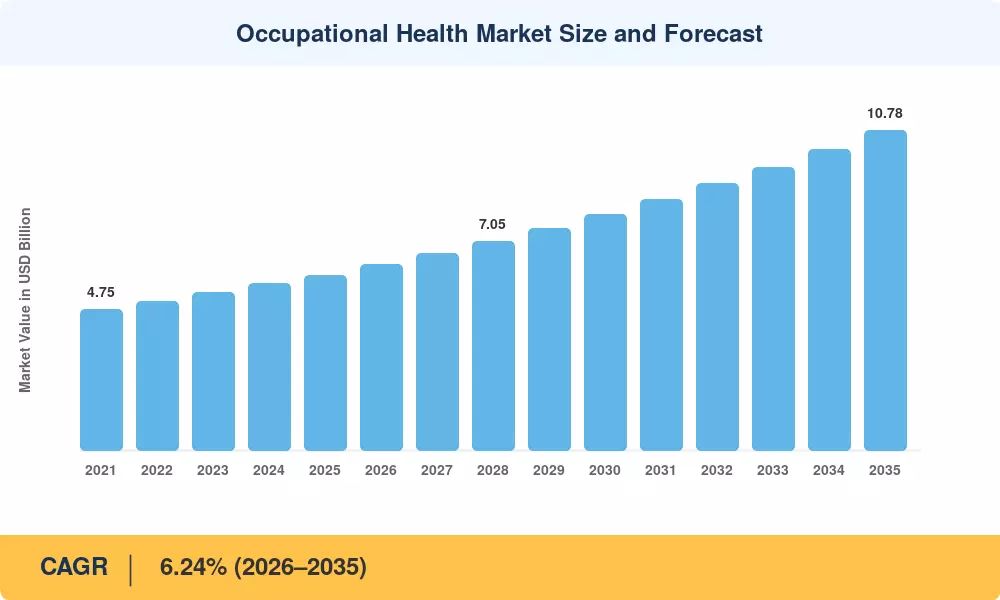
Occupational Health Market to Surge from USD 5.91 Bn in 2025 to USD 10.78 Bn by 2035—By Regulatory Tightening on Hazardous Exposure, Psychosocial Risk Mandates
NY, CA, UNITED STATES, September 8, 2026 /EINPresswire.com/ — As per Market Research Future, the global Occupational Health Market size is projected to reach USD 10.78 Billion by 2035 from USD 5.91 Billion in 2025, at a CAGR of 6.24% during the forecast period 2026–2035. The market base was estimated at USD 5.91 Billion in 2025, with the first year of the forecast period (2026) valued at USD 6.25 Billion.
The 6.24% CAGR is propelled by three converging forces: regulatory tightening on hazardous exposure, with the International Labour Organization’s 2022 decision to elevate a safe and healthy working environment to a fundamental principle at work pushing national labour inspectorates to tighten enforcement budgets and reporting requirements; psychosocial risk and mental health mandates, with employers now legally required to evaluate stress risk under current legislation in several jurisdictions, driving mental health services to expand at an 11.20% CAGR; and telehealth economics for distributed workforces, with virtual delivery collapsing the cost floor for employers too small to justify an on-site clinic and extending coverage to distributed and small-employer workforces at a 10.94% CAGR.
Global regulatory bodies and employers are amplifying this momentum. The World Health Organization and ILO jointly attribute roughly 1.9 million annual deaths to occupational risk exposure, reframing employer health spending from discretionary benefit to balance-sheet liability. The European Agency for Safety and Health at Work has built its 2023–2025 Healthy Workplaces Campaign around digitalisation of work, explicitly covering algorithmic management and remote-work health risk. The European Union’s Directive (EU) 2023/2668 cut the occupational asbestos exposure limit tenfold, triggering a multi-year surveillance procurement cycle across member states. North America holds 34.3% of the Occupational Health Market in 2025, sustained by OSHA recordkeeping obligations and employer-funded health infrastructure, while Asia-Pacific expands fastest at an 8.47% CAGR through 2035 as manufacturing employment formalises across India, Vietnam, and Indonesia.
Request A Free Sample:
https://www.marketresearchfuture.com/sample_request/43100
Key Market Trends & Growth Drivers
Regulatory Tightening on Hazardous Exposure
Europe reset the compliance baseline when Directive (EU) 2023/2668 cut the occupational exposure limit for asbestos to 0.01 fibres per cubic centimetre, a tenfold reduction with a transition path running to 2029. Member states must build surveillance registers for exposed workers, which converts a one-off remediation cost into a multi-year medical monitoring contract. The European Commission estimates that a large share of the EU building stock predates asbestos bans, putting several million construction workers inside the surveillance perimeter.
Psychosocial Risk Becomes a Statutory Duty
In a number of jurisdictions, mental health transitioned from a voluntary benefit to an inspected duty between 2023 and 2025. The UK Health and Safety Executive’s Working Minds campaign makes clear that employers are legally required to evaluate stress risk, and inspectors now ask for proof of this evaluation during routine visits. Demand changed away from app-only services and toward manager training, clinician-led escalation procedures, and systematic psychosocial evaluations. This service line is expanding at 11.20% CAGR.
Telehealth Economics for Distributed Workforces
Virtual delivery collapsed the cost floor for employers too small to justify an on-site clinic. A remote fitness-for-duty consultation can be delivered at a fraction of the fully loaded cost of a staffed clinic hour, and scheduling density improves clinician utilisation materially. EU-OSHA’s 2023–2025 campaign on digital-age working conditions has legitimised remote occupational assessment within regulatory guidance, easing procurement resistance. Micro-enterprises consequently grow at a 9.61% CAGR.
Musculoskeletal Disorder Burden
In industrialized economies, ergonomic injuries continue to be the leading cause of missed workdays. Employers switched from post-injury physiotherapy referrals to predictive assessment, using camera-based motion capture to score lifting posture in real time and only triggering clinician evaluation over a risk threshold. This model increases the number of workers assessed while decreasing the cost per assessed worker.
Ask for Customization:
https://www.marketresearchfuture.com/ask_for_customize/43100
Market Segment Insights
BY SERVICE TYPE
Drug & Alcohol Testing: Largest segment with 34.3% share in 2025, reflecting mandatory testing regimes in transport, mining, and energy. Demand is legally compelled rather than economically chosen.
Mental Health Services: Fastest-growing segment at 11.20% CAGR (2026–2035) , as psychosocial risk assessment becomes a statutory duty in several jurisdictions. Growth is rapid, pricing is favourable, and delivery models remain unsettled.
Health Risk Assessment: Significant segment with 14.8% share in 2025 , driven by insurer premium differentiation.
Injury Care & Case Management: Growing at 7.05% CAGR (2026–2035) , driven by workers’ compensation duration control.
BY SERVICE LOCATION
On-Site Clinics: Largest segment at USD 2.36 Billion in 2025, remaining the anchor delivery channel for large industrial employers. Proximity eliminates the productivity loss of off-site travel.
Telehealth / Virtual Platforms: Fastest-growing location at 10.94% CAGR (2026–2035) , extending coverage to distributed and small-employer workforces. Handling triage and follow-up while reserving physical capacity for procedures that genuinely require presence.
Off-Site / Third-Party Clinics: Significant segment with 24.6% share in 2025 , providing flexible capacity for mid-sized employers.
Near-Site Shared Clinics: Significant segment with 15.3% share in 2025 , serving industrial park and business district clustering.
BY APPLICATION
Physical Wellbeing: Largest segment with 38.7% share in 2025 , driven by musculoskeletal and chronic disease burden. Maps directly onto measurable claim costs.
Social & Mental Wellbeing: Fastest-growing application at 9.82% CAGR (2026–2035) , driven by statutory psychosocial risk duties.
Occupational Safety & Ergonomic Wellbeing: Significant segment at USD 1.27 Billion in 2025, driven by injury reduction and ergonomic redesign.
BY ORGANISATION SIZE
Large Enterprises: Largest segment with 46.1% share in 2025 , driven by statutory thresholds and dedicated HR infrastructure.
Micro Enterprises: Fastest-growing segment at 9.61% CAGR (2026–2035) , driven by low-cost digital delivery removing affordability barriers.
Very Large Enterprises: Significant segment at USD 1.61 Billion in 2025, driven by multi-site programme standardisation.
Read Detailed Insights:
https://www.marketresearchfuture.com/reports/occupational-health-market-43100
Regional Outlook
North America — Dominant Market (~34.3% Share, 2025)
United States: Generates approximately 82.6% of North American revenue, sustained by OSHA recordkeeping obligations and workers’ compensation experience rating. Employer economics dominate this region—every avoided lost-time claim flows directly to operating income.
Canada: Contributes USD 0.22 Billion, driven by provincial WSIB return-to-work mandates.
Mexico: Fastest-growing in the region at 7.14% CAGR (2026–2035) , driven by NOM-035 psychosocial risk standard enforcement.
Europe — Second Largest (~28.6% Share, 2025)
Germany: Holds 24.8% of regional share , driven by the Betriebsarzt statutory company physician requirement, creating a guaranteed demand floor.
United Kingdom: Contributes USD 0.31 Billion, driven by HSE stress risk assessment duty.
France: Holds 16.2% of regional share , driven by Services de prévention et de santé au travail reform.
Italy: Contributes USD 0.16 Billion, driven by Legislative Decree 81/2008 health surveillance.
Spain: Holds 6.9% of regional share , driven by construction sector asbestos remediation.
Nordic Countries: Fastest-growing in the region at 7.31% CAGR (2026–2035) , driven by outcome-based occupational health contracting.
Russia: Contributes USD 0.07 Billion, driven by heavy industry mandatory periodic examinations.
Rest of Europe: Holds 8.4% of regional share , driven by CEE manufacturing relocation.
Asia-Pacific — Fastest-Growing Region (8.47% CAGR, 2026–2035)
China: Holds 31.6% of regional share , driven by occupational disease prevention law enforcement in heavy industry.
India: Fastest-growing in the region at 10.42% CAGR (2026–2035) , driven by OSH Code consolidation and factory inspection expansion. Represents the largest untapped pool—enormous industrial employment against limited accredited clinical capacity.
Japan: Contributes USD 0.29 Billion, driven by Stress Check Programme statutory requirement.
South Korea: Holds 11.7% of regional share , driven by Serious Accidents Punishment Act executive liability, exposing senior executives to criminal liability for severe workplace incidents.
ASEAN: Contributes USD 0.17 Billion, driven by electronics and garment supply-chain audit requirements.
South America — Growing Presence (USD 0.40 Billion, 2025)
Brazil: Anchors the region with 61.3% of revenue , driven by eSocial digital reporting and PCMSO medical control programme.
Argentina: Contributes USD 0.06 Billion, driven by ART workers’ compensation insurer requirements.
Middle East & Africa — Emerging Opportunity (USD 0.34 Billion, 2025)
Saudi Arabia: Holds 33.8% of regional share , driven by Vision 2030 megaproject workforce health mandates.
UAE: Contributes USD 0.08 Billion, driven by midday work ban compliance and labour accommodation health.
South Africa: Holds 19.4% of regional share , driven by Mine Health and Safety Act medical surveillance.
Egypt: Fastest-growing in the region at 9.62% CAGR (2026–2035) , driven by industrial zone expansion and labour law reform.
Competitive Landscape and Recent Developments
Concentration is moderate and geographically uneven. Estimated top-five combined share sits near 28–32% globally, with a corresponding HHI in the low hundreds—characteristic of a fragmented sector where national clinical networks, software vendors, and insurer-affiliated providers compete from different starting positions.
KEY COMPANIES AND RECENT MILESTONES
Concentra Group Holdings (July 2024): Completed an initial public offering on the New York Stock Exchange, separating from Select Medical and giving the sector its largest pure-play listed occupational medicine operator. Estimated ~7–9% revenue share.
Sonic Healthcare (2024): Extended its European laboratory and clinical services footprint through acquisition, strengthening the diagnostics base that underpins its health surveillance offering. Estimated ~5–7% revenue share.
Optum (UnitedHealth Group): Payer-integrated with strongest data and risk-modelling assets. Employer clinics, behavioural health, and population health analytics. Estimated ~4–6% revenue share.
Marsh McLennan (Mercer Marsh Benefits): Advisory-led entry point into employer health budgets. Health risk consulting, programme design, and benefits integration. Estimated ~3–5% revenue share.
Medcor: Triage-first model with strong construction and logistics penetration. On-site and near-site clinics, injury triage, and telehealth triage. Estimated ~3–4% revenue share.
Wolters Kluwer (Enablon): Enterprise software incumbent in heavy industry. EHS software, incident management, and exposure recordkeeping. Estimated ~2–3% revenue share.
Cority Software: Purpose-built OHIS platform with deep clinical workflow coverage. Occupational health information systems and industrial hygiene modules. Estimated ~2–3% revenue share.
VelocityEHS: AI-assisted ergonomics differentiation. Ergonomics assessment, chemical management, and health analytics. Estimated ~2–3% revenue share.
Medigold Health: UK mid-market specialist with national clinician network. Health surveillance, absence management, and wellbeing services. Estimated ~1–2% revenue share.
Axiom Medical: Outsourced case management focus for US employers. Injury case management, behavioural health, and return-to-work. Estimated ~1–2% revenue share.
Examinetics: Mobile-unit specialist serving multi-site industrial clients. Mobile audiometric and respiratory screening. Estimated ~1–2% revenue share.
Recent Industry Developments:
OSHA (August 2024): Published a proposed rule on heat injury and illness prevention covering both indoor and outdoor work settings, establishing acclimatisation, monitoring, and rest-break obligations.
European Union (December 2023): Directive (EU) 2023/2668 entered into force, cutting the occupational asbestos exposure limit tenfold and mandating registers of exposed workers.
EU-OSHA (October 2023): Launched the Healthy Workplaces Campaign 2023–2025 on safe and healthy work in the digital age.
India, Ministry of Labour and Employment (2023–2025): Continued phased operationalisation of the Occupational Safety, Health and Working Conditions Code, consolidating thirteen prior statutes.
ILO (April 2024): Published analysis quantifying the scale of workforce exposure to excessive heat, elevating climate adaptation within national safety agendas.
Future Outlook: 2026–2035
The Occupational Health Market is projected to reach USD 10.78 Billion by 2035, growing at a CAGR of 6.24%, driven by regulatory tightening on hazardous exposure, psychosocial risk mandates, and telehealth economics for distributed workforces.
New opportunities lie in:
Predictive Analytics on Longitudinal Exposure Records: Providers with ten years’ worth of audiometry, spirometry, and biological monitoring results can model claim probability from exposure history, creating a recurring revenue line separate from clinical fees.
Virtual-First Coverage for Distributed and Gig Workforces: Subscription models combining scheduled virtual consultations, asynchronous triage, and contracted physical venues serve platform and remote-first employers at low marginal cost.
Emerging-Market Formalisation: India’s OSH Code and similar consolidation across ASEAN extend coverage obligations to establishments previously outside the net. Providers establishing accredited local capacity ahead of enforcement capture first-mover share.
Integrated Return-to-Work Case Management: Bundling clinical treatment, insurer liaison, and graduated return-to-duty planning into a single accountable contract lets providers price on outcomes—days saved—rather than encounters delivered.
Heat and Climate-Related Health Programmes: OSHA’s proposed heat injury and illness prevention rule and Gulf state mandates are creating a service category that barely existed a decade ago.
AI-Assisted Clinical Triage: Algorithmic pre-screening of audiometry and spirometry results, automated flagging of abnormal biological monitoring values, and natural-language summarisation of occupational histories compress physician review time substantially.
By 2035, the Occupational Health Market is expected to demonstrate robust growth, reflecting the transformation of occupational health from a compliance-driven expense to a strategic investment in workforce productivity and well-being.
More Related Research Insights:
https://www.marketresearchfuture.com/fr/reports/energy-based-aesthetic-devices-market-32726
https://www.marketresearchfuture.com/ja/reports/energy-based-aesthetic-devices-market-32726
https://www.marketresearchfuture.com/de/reports/energy-based-aesthetic-devices-market-32726
https://www.marketresearchfuture.com/es/reports/energy-based-aesthetic-devices-market-32726
https://www.marketresearchfuture.com/zh-cn/reports/energy-based-aesthetic-devices-market-32726
https://www.marketresearchfuture.com/ko/reports/energy-based-aesthetic-devices-market-32726
https://www.marketresearchfuture.com/fr/reports/healthcare-consulting-services-market-7860
https://www.marketresearchfuture.com/ja/reports/healthcare-consulting-services-market-7860
https://www.marketresearchfuture.com/de/reports/healthcare-consulting-services-market-7860
https://www.marketresearchfuture.com/es/reports/healthcare-consulting-services-market-7860
Market Research Future
Market Research Future
+1 855-661-4441
email us here
Legal Disclaimer:
EIN Presswire provides this news content “as is” without warranty of any kind. We do not accept any responsibility or liability
for the accuracy, content, images, videos, licenses, completeness, legality, or reliability of the information contained in this
article. If you have any complaints or copyright issues related to this article, kindly contact the author above.

Media gallery