
Key Takeaways
- The right travel watercolor kit depends on priorities: ready-to-paint convenience, a student-grade color range, or a narrow themed palette for a specific style
- The Cotman Sketchers’ Pocket Set includes 12 student-grade half pans and a travel brush, but it ships without paper, so a sketchbook has to be bought separately
- The Aquafine Turner Tate Set offers six Turner-inspired watercolors, three brushes, and a postcard-size pad, which works well for warm, atmospheric painting but limits range beyond that style
- Watercolor paper rated at least 140 lb (300gsm) helps wet washes resist warping, a detail worth checking before any travel kit gets packed for a trip
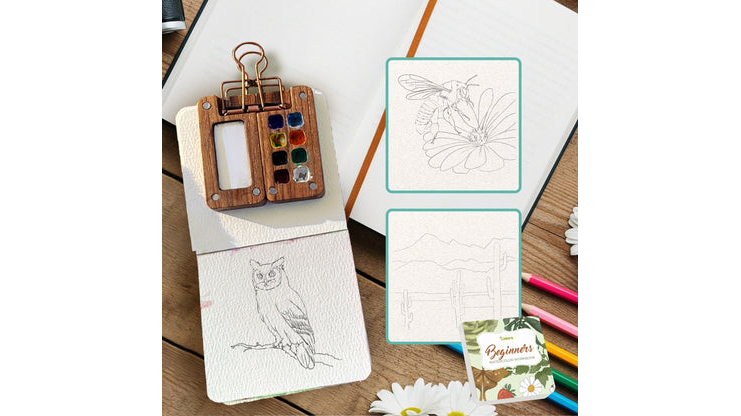
- Tobio’s Kits’ watercolor pack bundles 12 paint tubes, a cotton-paper sketchbook, a travel water brush, and a walnut palette into one compact case – find out how the three kits stack up below
Picking a watercolor travel kit sounds simple until the choices start piling up. Some kits hand over rich color but skip the paper. Others look appealing on a shelf but leave out a brush worth packing. Knowing what each kit actually includes, rather than what it looks like in a product photo, is the difference between painting on the first afternoon of a trip and spending that afternoon hunting for supplies instead.
Three kits come up again and again in conversations among beginner painters: the Winsor & Newton Cotman Sketchers’ Pocket Set, the Daler-Rowney Aquafine Turner Tate Set, and Tobio’s Watercolor Kit. Each one takes a different approach to what counts as travel-ready.
What Travels In Each Kit
The fastest way to compare these three kits is to look at what lands in the box the moment it arrives. The Cotman Sketchers’ Pocket Set holds 12 student-grade half pans made with Winsor & Newton’s fine art pigments, plus a single travel brush. Color-wise, the set covers a practical spread: yellow, red, blue, green, earth tones, and Chinese White, all tucked into a pocket-sized box with a lid that doubles as a mixing palette. Paper is not included, which matters more than it might seem at first glance.
The Aquafine Turner Tate Set takes a narrower, more artistic route. It includes six 8 ml watercolor tubes chosen to echo the warm, glowing tones of J.M.W. Turner’s The Scarlet Sunset, along with three brushes and a smooth postcard-format pad measuring 14.8 by 10 centimeters with ten sheets. Everything in the set points toward one mood: soft, atmospheric washes built from a tight, warm palette.
A Tobio’s watercolor kit rounds out the comparison with 12 watercolor tubes, a cotton-paper sketchbook, a travel water brush, a walnut palette, and a compact case. The palette clips directly onto the sketchbook, creating a stable painting surface without needing a table. That detail alone solves a problem the other two kits leave unaddressed: where exactly does a painter set things up when there is no flat surface nearby?
What Every Travel Kit Needs
Before comparing kits side by side, it helps to know what actually makes a watercolor setup travel-friendly in the first place. A kit that looks complete in a photo can still leave gaps once it is tested outdoors, so three elements are worth checking every time: color range, paper quality, and portability.
Color Range and Paint Format
A workable travel palette usually needs at least 12 colors covering warm tones, cool tones, and strong primaries for mixing. Fewer colors can still produce beautiful work, but they narrow what is possible once a scene calls for a color outside that range. This is exactly where the Aquafine Turner Tate Set shows its personality: six colors built specifically for warm, atmospheric painting deliver pleasing sunsets and soft skies, but a cool blue ocean or a bright green forest will ask more of that palette than it can comfortably give.
Paint format matters just as much as the count. Half pans, like the ones in the Cotman set, store compactly and won’t spill in a bag. Tubes, like those in the Aquafine and Tobio’s kits, arrive moist and ready to blend without the extra step of wetting a dry pan first.
Paper That Handles Wet Washes
Watercolor paper needs enough weight to survive repeated wet washes without buckling or tearing. A weight of at least 140 lb (300gsm) is generally recommended to keep paper flat and workable, especially for beginners still learning how much water a brush should hold. Thin paper can warp or pill under a heavy wash, which turns a simple sketch into a frustrating cleanup.
This is the category where the Cotman Sketchers’ Pocket Set falls short for anyone packing light: it includes no paper at all, so a sketchbook becomes a separate purchase and a separate thing to remember. The Aquafine set includes a postcard-size pad, which works for small studies but limits the scale of anything more ambitious. A cotton-paper sketchbook, by contrast, gives a painter one less thing to think about before a trip.
Brushes, Palette, and Portability
A travel brush that holds its own water, often called a water brush, removes the need to carry a separate cup, which matters a lot when painting standing up or balancing a sketchbook on a knee. A small mixing palette, even a built-in lid, lets colors blend without muddying the main paint supply. And a compact case ties it all together so nothing rattles loose in a bag.
All three kits address portability differently. The Cotman set folds its palette into the lid of its pocket box. The Aquafine set skips a dedicated case or palette altogether, relying on the postcard pad itself as the working surface. A walnut palette that clips onto a sketchbook provides a third option: a stable surface that travels attached to the paper, rather than as a separate piece to track down.
Pans vs Tubes on the Road
One of the most practical decisions in choosing a travel kit comes down to paint format: half pans or tubes. Each has clear strengths depending on how and where painting happens.
Why Pans Favor Quick Setup
Half pans keep colors locked in place inside a compact box, which makes them a favorite for painters who want to open a kit and start immediately. The Watercolourist notes that half pans favor portability and quick setup, since a painter can flip open a pocket box and get to work without squeezing anything out first. Pans also fit more colors into less space than tubes, which is part of why the Cotman Sketchers’ Pocket Set manages to pack 12 colors into something that fits in a jacket pocket.
Why Tubes Favor Bigger Washes
Tubes shine when a painting calls for large, even washes. Moist tube paint disperses into a mixing area immediately, while dry pan paint needs a moment of wetting before a brush can lift enough color to work with, a distinction The Watercolourist draws out clearly. For sweeping skies or broad backgrounds, that immediate availability saves time and keeps color consistent across a larger area. The tradeoff shows up in warm weather: tube paint left open on a palette can stay sticky, which raises the risk of colors mixing together by accident during travel.
Mixing Tube Paint Into Pans
Some painters try to get the best of both worlds by squeezing tube paint into empty pans and letting it dry into a semi-solid form. This works, but it takes patience. A manufacturer technical guide notes that tube paint can be layered into pans, with each layer left to dry before the next is added, and the filled pans left open to air-dry before the travel case is closed. In low humidity around 20 percent, a full pan may be ready in a couple of days; above 50 percent humidity, drying can stretch past a week. Even then, tube paint is not formulated to dry as flexibly as true pan paint, so it can crack or split over repeated use, which is worth knowing before converting an entire palette this way.
Three Kits, Three Priorities
Stepping back, each kit clearly serves a different kind of painter, and none of them is trying to be all three things at once.
A Pocket-Size Student Staple
The Cotman Sketchers’ Pocket Set earns its reputation as a dependable outdoor sketching companion. Its 12 half pans deliver reliable, student-grade color at an approachable price, and the pans can be refilled or expanded using individual colors from Winsor & Newton’s 40-color Cotman range. That refillability makes it a kit that can grow alongside a painter’s skill, though the missing paper means budgeting for a sketchbook before heading out the door.
A Narrow, Thematic Palette
The Aquafine Turner Tate Set leans into mood over versatility. Its six colors are centered on warm, atmospheric painting, built to recreate the soft glow found in Turner’s work. For a painter chasing golden hour skies or misty landscapes, this kit delivers exactly that feeling right out of the box. For anyone wanting to paint a wider variety of scenes, the limited range becomes noticeable fairly quickly.
A Ready-to-Paint Setup
This kit takes a different angle by bundling paint, paper, brush, and palette into a single ready-to-use package. The walnut palette clips directly to the cotton-paper sketchbook, creating a stable painting surface without a table. A separate Beginner Workbook, offering 30 pre-sketched illustrations, is also available and bundles with the kit at a lower price for anyone who wants guided practice before working from a blank page.
Completeness Decides the Better Travel Kit
None of these three kits wins outright in every situation. The Cotman Sketchers’ Pocket Set wins on expandability and trusted student-grade pigment. The Aquafine Turner Tate Set wins on mood and ease of use for a specific warm palette. Completeness is what separates them most clearly: a kit that includes paint, paper, brush, and palette together means one less errand before a trip and one less reason to hesitate before the first brushstroke.
For anyone ready to pack light and paint sooner, Tobio’s Kits has more resources recommending that your chosen watercolor travel kit actually includes paper and a palette before assuming it’s ready to go.
Tobio’s Kits
info@tobioshop.com
+1 (305) 257-6512
3833 Powerline Road
Ste 201
Fort Lauderdale
Florida
33309
United States


